
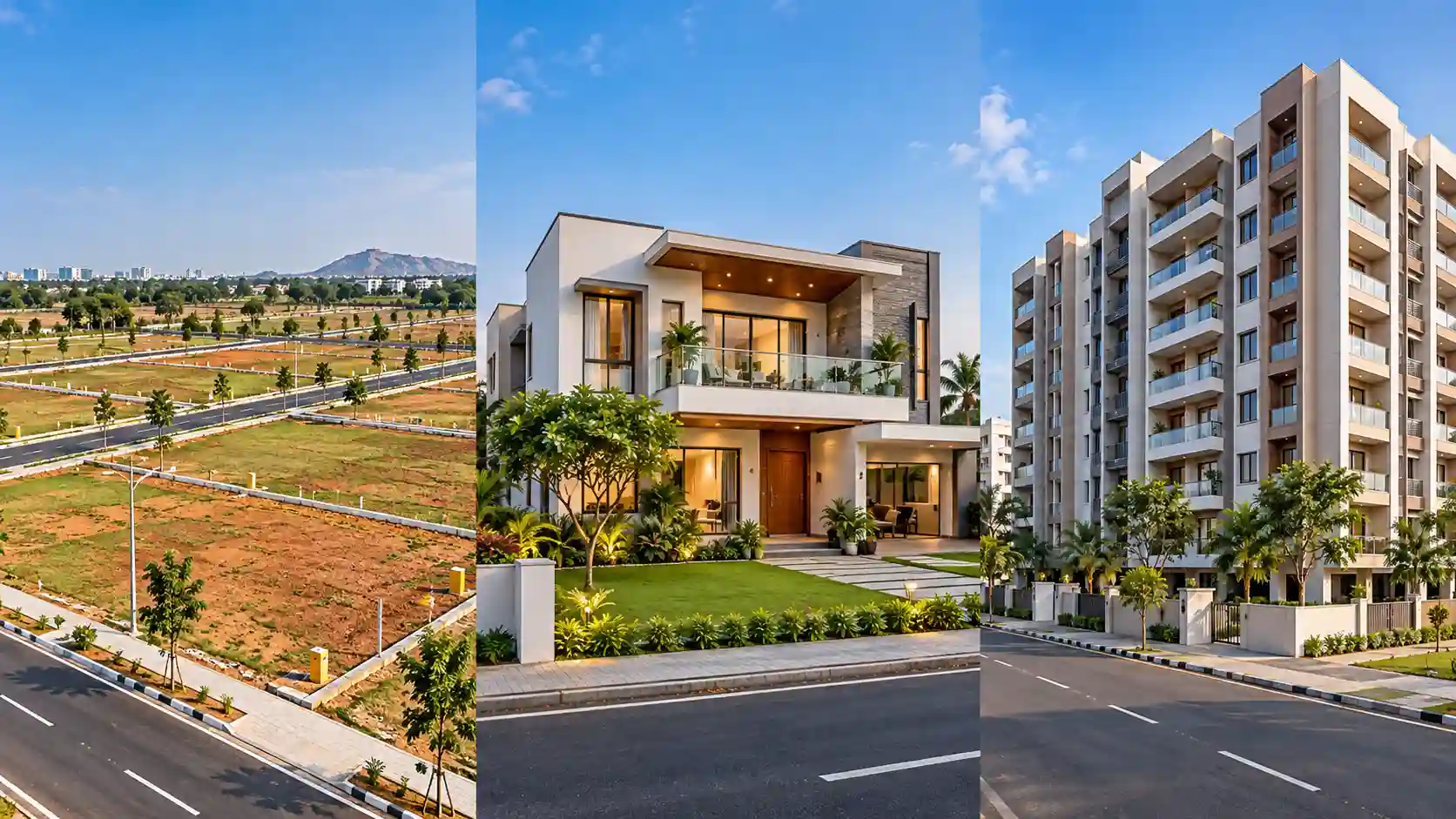
The plot vs villa vs apartment decision can feel confusing because each property type offers a different kind of ownership, lifestyle and responsibility.
A plot gives you land and the freedom to plan construction later. A villa gives you an independent-style home with more private space. An apartment offers a residential unit within a shared building or community.
There is no single option that is right for every buyer.
Your decision should depend on your budget, preferred location, family size, lifestyle, maintenance expectations and future plans.
This guide explains the differences in simple English so you can compare each option more clearly.
1. Plot vs Villa vs Apartment: Understand the Basic Difference
Before comparing prices, first understand what you are buying.
Plot
A plot is mainly a piece of land.
If the property and applicable rules allow it, you may later build a home based on your needs and approved building plans.
Villa
A villa is usually an independent or semi-independent house. It may be part of a gated residential community.
Depending on the project, a villa may offer:
- Private entrance
- More living space
- Parking
- Small garden or outdoor area
- Community amenities
- Greater privacy
Apartment
An apartment is a residential unit within a larger building.
Residents usually share facilities such as:
- Lifts
- Corridors
- Parking
- Security
- Common spaces
- Community amenities
A simple comparison:
| Factor | Plot | Villa | Apartment |
|---|---|---|---|
| What you buy | Land | House/property | Residential unit |
| Ready to live | No | Often yes | Often yes |
| Design freedom | High | Moderate | Limited |
| Privacy | High after construction | Usually high | More shared |
| Maintenance | Mostly individual | Individual + community | Shared maintenance |
| Amenities | Depends on layout | Often available | Often available |
The right property type depends on what you actually need.
2. Plot vs Villa vs Apartment: Compare Your Budget
Budget is one of the first things buyers should consider.
Do not compare only the advertised purchase price.
Plot costs may include:
- Land price
- Registration-related costs
- Legal verification
- Site preparation
- Architect or engineer fees
- Construction
- Utility connections
- Compound wall
- Landscaping
Villa costs may include:
- Purchase price
- Registration
- Interiors
- Community maintenance
- Repairs
- Landscaping
Apartment costs may include:
- Purchase price
- Registration
- Interiors
- Maintenance charges
- Parking, where separately applicable
- Community charges
A lower initial price does not always mean a lower total cost.
Calculate the complete financial commitment before deciding.
3. Decide How Soon You Need the Property
Ask yourself:
Do I need a home now, or am I planning for later?
If you need to move in soon, a completed villa or ready apartment may be more practical.
A plot requires another important step:
construction.
That may involve:
- Planning
- Building approval
- Architect
- Contractor
- Materials
- Construction supervision
- Additional budget
- Time
If you already have a place to live and want to build your own house later, a plot may fit your timeline better.
Your expected move-in date can help narrow your choices.
4. Plot vs Villa vs Apartment for Space Requirements
Think about how much space you actually need.
An apartment may suit:
- Couples
- Small families
- People who prefer compact living
- Buyers who value shared amenities
A villa may suit buyers looking for:
- More bedrooms
- Private parking
- Outdoor space
- Greater privacy
- Larger family living
A plot allows you to plan your future home according to your needs, subject to relevant approvals and building rules.
Do not choose more space simply because it looks premium.
Choose what you can comfortably use and maintain.
5. Location Can Matter More Than Property Type
Suppose you prefer a villa, but it is far from your workplace.
At the same budget, an apartment may be available closer to the places you use every day.
That could make the apartment more practical.
Before deciding, check the distance from:
- Workplace
- Schools
- Hospitals
- Main roads
- Public transport
- Grocery stores
- Family
- Important city areas
A good property in the wrong location can still become inconvenient.
You can browse available options on the UniqNest Projects page.

6. Plot vs Villa vs Apartment for Design Freedom
If you want to design your own home, a plot usually provides the most flexibility.
Depending on applicable rules, you may plan:
- Room sizes
- Bedrooms
- Kitchen layout
- Parking
- Garden
- Home office
- Terrace
- Future extensions
A villa may provide some flexibility, especially during an early construction stage, but the basic design usually comes from the developer.
An apartment normally offers less structural freedom.
You can often personalise:
- Furniture
- Lighting
- Interior colours
- Storage
- Finishes
But major structural changes may not be allowed.
If customisation matters strongly to you, include it in your property comparison.
7. Compare Privacy Levels
Privacy is another major difference.
Plot and independent house
After construction, you may have more control over:
- Entry
- Parking
- Outdoor space
- House layout
Villa
A villa can provide more independent living while still being part of a residential community.
Apartment
Apartment residents share:
- Lifts
- Corridors
- Parking
- Entrances
- Amenities
Some buyers enjoy this community environment.
Others prefer more personal space.
Neither lifestyle is automatically better. Choose what suits your family.
8. Plot vs Villa vs Apartment: Maintenance Differences
Maintenance should be considered before buying.
Plot
An empty plot may require:
- Cleaning
- Boundary monitoring
- Fencing
- Periodic visits
- Vegetation control
Villa
A villa may require:
- Building repairs
- Plumbing maintenance
- Electrical maintenance
- Garden care
- Community charges
Apartment
Apartment owners usually pay maintenance for common services such as:
- Security
- Lifts
- Cleaning
- Landscaping
- Common electricity
- Shared amenities
Think about both the cost and the time needed for maintenance.
9. Compare Amenities Carefully
Apartments and gated villa communities may provide amenities such as:
- Gym
- Clubhouse
- Security
- Children’s play area
- Walking track
- Sports facilities
- Landscaped areas
- Community hall
A standalone plot may not automatically include these facilities.
Ask yourself:
Will my family actually use these amenities?
Do not pay a large premium only because a project has a long list of facilities.
Useful amenities matter more than the total number of amenities.
10. Check Documents for Every Property Type
Whether you select a plot, villa or apartment, property verification is important.
For plots, check relevant records such as:
- Ownership
- Sale deed
- Survey details
- Layout approval
- Land use
- Road access
- Encumbrance information
For villas or apartments, relevant checks may include:
- Project title
- Approved plans
- Building permissions
- Agreement details
- Applicable RERA details
- Property specifications
- Common-area details
You can read the UniqNest guide on documents to verify before buying land.
Do not assume that professional marketing means all documents are automatically clear.
Independent legal verification can be useful before making a significant commitment.
11. Plot vs Villa vs Apartment for Community Living
If community living matters to you, property type can make a difference.
Apartments often provide:
- Neighbours nearby
- Common play areas
- Security
- Community events
- Shared facilities
Villa communities may provide similar benefits while offering more private space.
A standalone plot and independent house may give you greater privacy, but community facilities depend on the location and development.
Think about how you and your family prefer to live every day.
12. Consider Construction Responsibility
A plot gives you more freedom, but that also means more responsibility if you build later.
You may need to coordinate with:
- Architect
- Engineer
- Contractor
- Labour
- Material suppliers
- Relevant authorities
You may also need to track:
- Budget
- Construction quality
- Materials
- Timeline
- Permissions
With an apartment or villa project, the developer usually manages the main construction.
If you do not want to manage construction yourself, this difference may be important.
13. Plot vs Villa vs Apartment for Future Plans
Do not make the decision only for your present situation.
Think about the next five or ten years.
Ask:
- Could my family become larger?
- Will parents live with me?
- Do I want a garden?
- Will I continue working in the same area?
- Could I relocate?
- Do I want to build another floor later?
- Will I still want community amenities?
A property should support your future plans as well as your current needs.
14. Do Not Choose Based Only on Future Price Growth
You may hear statements like:
“Plots always appreciate more.”
“Villas give better returns.”
“Apartments are easier to resell.”
These statements are too broad to apply to every property.
Future performance can depend on:
- Exact location
- Demand
- Infrastructure
- Property condition
- Project quality
- Supply
- Legal clarity
- Market conditions
No property type guarantees future appreciation.
Choose based first on suitability, affordability and verification.
15. Plot vs Villa vs Apartment: Quick Comparison

| Feature | Plot | Villa | Apartment |
|---|---|---|---|
| Immediate use | No | Often possible | Often possible |
| Design freedom | High | Medium | Low |
| Privacy | High after construction | High | Moderate |
| Construction responsibility | Buyer | Mostly developer | Developer |
| Maintenance | Individual | Individual/community | Shared |
| Amenities | Depends | Often available | Often available |
| Outdoor space | Can be planned | Often private | Usually shared/limited |
| Community living | Depends | Moderate–High | High |
| Best suited to | Future custom home | Space & privacy | Convenience |
This table should be used as a starting point.
Your personal needs should decide the final choice.
16. Questions to Ask Before Choosing a Property Type
Before deciding, answer these questions:
- What is my complete budget?
- Do I need a ready property?
- Do I want to design my own home?
- How much space does my family need?
- How important is privacy?
- Do I want shared amenities?
- Can I manage construction?
- Which location works for my daily commute?
- How much maintenance can I comfortably handle?
- What are my plans for the next 5–10 years?
- Have I checked the documents?
- Have I compared similar properties?
These questions can make the plot vs villa vs apartment comparison much clearer.
Common Mistakes When Comparing Plot vs Villa vs Apartment
Avoid:
- Choosing only by price
- Ignoring location
- Buying more space than you need
- Forgetting maintenance costs
- Ignoring future construction expenses
- Paying for amenities you will not use
- Skipping document verification
- Choosing because of sales pressure
- Assuming future appreciation is guaranteed
You can also read our First-Time Buyer Mistakes guide.
Which Property Type May Fit Your Needs?
A plot may fit buyers who want to build their own home later and prefer greater control over the design.
A villa may fit buyers looking for more privacy and space without starting construction from the beginning.
An apartment may fit buyers who value convenience, shared facilities and community living.
There is no universal winner.
The suitable option depends on your own budget, lifestyle and plans.
FAQs About Plot vs Villa vs Apartment
Is a plot better than an apartment?
It depends on your purpose. A plot may offer more future design flexibility, while an apartment may offer faster usability and shared amenities.
Is a villa more private than an apartment?
Villas generally provide more independent living space, although the exact level of privacy depends on the project design.
Is buying a plot cheaper than buying a villa?
Not necessarily. A plot may require future construction costs, so buyers should compare total expenses rather than only the initial purchase price.
Which option requires less maintenance?
Apartments often provide shared maintenance for common areas, while villas and independent homes may require more individual upkeep.
Which property type should a first-time buyer choose?
There is no single answer. First-time buyers should compare their budget, location requirements, lifestyle, timeline and documentation before deciding.
Final Thoughts on Plot vs Villa vs Apartment
The plot vs villa vs apartment decision becomes easier when you stop asking:
“Which property type is best?”
and instead ask:
“Which property type fits my life?”
Compare:
Budget + Location + Space + Privacy + Maintenance + Timeline + Documents
If you want complete design freedom and can wait for construction, a plot may be worth exploring.
If you want more private living space in a completed development, consider villas.
If convenience and community facilities are important, apartments may deserve closer consideration.
At UniqNest, you can explore different property types according to your location and requirements.
You can explore properties, contact UniqNest or visit the UniqNest homepage.
You can also read:
- Open Plots vs Apartments
- Documents to Verify Before Buying Land
- First-Time Buyer Mistakes
- Land in Vijayawada Buyer Guide
Compare carefully. Verify the details. Choose what suits your future.
Disclaimer: This article is for general informational purposes only and is not legal, financial or investment advice. Property prices, documents, permissions and regulations can vary depending on the location and property. Buyers should independently verify relevant information and obtain appropriate professional advice before purchasing.