
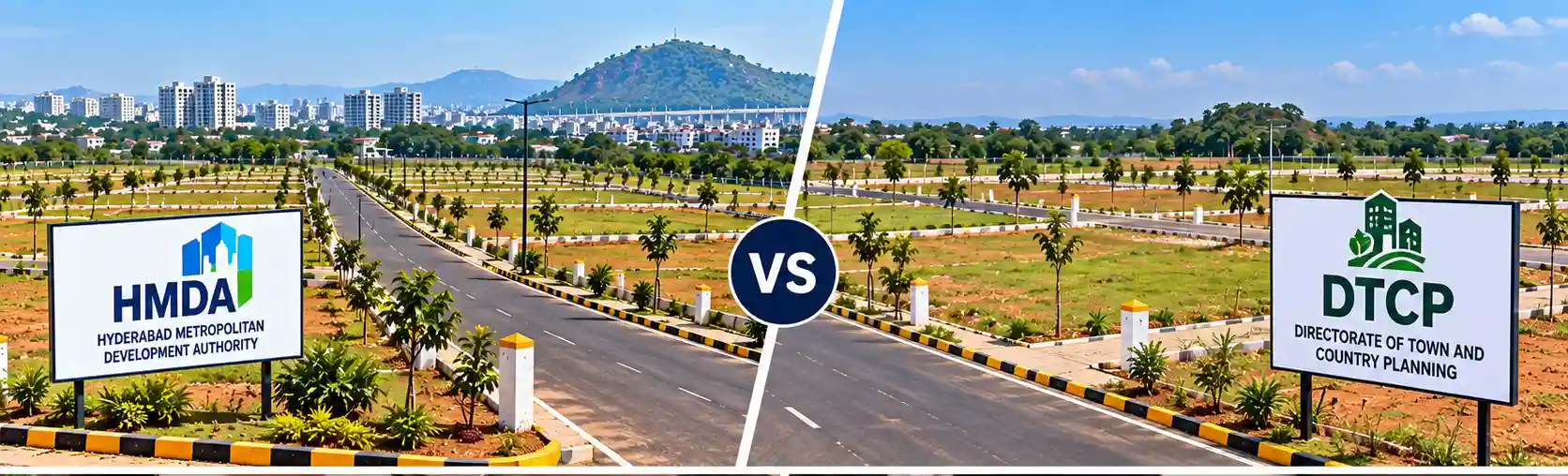
HMDA vs DTCP plots can be confusing for property buyers, especially when advertisements repeatedly use terms such as “HMDA approved” and “DTCP approved.” Both terms relate to planning and layout approval, but the authority that applies depends mainly on the location of the property.
For buyers, the important question is not simply which name sounds better. You should understand which authority has jurisdiction over the location, whether the layout has valid approval, and whether the plot shown to you matches the approved plan.
This guide explains HMDA and DTCP in simple terms and highlights the basic checks buyers should make before purchasing a plot.
1. HMDA vs DTCP Plots: What Is the Basic Difference?
The main difference between HMDA vs DTCP plots is the planning authority connected with the location.
HMDA stands for Hyderabad Metropolitan Development Authority. It is associated with planning and development within the Hyderabad Metropolitan Region.
DTCP stands for Directorate of Town and Country Planning. DTCP-related approvals generally apply in areas where that planning authority has jurisdiction rather than HMDA or another urban development authority.
In simple terms:
| Factor | HMDA | DTCP |
|---|---|---|
| Full Form | Hyderabad Metropolitan Development Authority | Directorate of Town and Country Planning |
| Main Role | Metropolitan planning and development control | Town and country planning |
| Approval relevance | HMDA jurisdiction | DTCP jurisdiction |
| Buyer should verify | HMDA approval records | DTCP approval records |
| Key question | Is HMDA the correct authority? | Is DTCP the correct authority? |
The correct authority depends on the location of the land.
2. What Are HMDA Approved Plots?
An HMDA-approved plot generally refers to a plot located within a layout that has received the required planning approval from HMDA, where HMDA is the competent authority.
When considering an HMDA layout, check:
- Layout approval number
- Approved layout plan
- Survey number
- Plot number
- Road widths
- Open spaces
- Plot dimensions
- Approval conditions
- Land-use information
Do not depend only on a sales representative saying:
“This is HMDA approved.”
Ask to see the actual supporting documents.
An approval claim is more useful when you can verify the approval number and approved plan.
3. What Are DTCP Approved Plots?
DTCP-approved plots generally refer to plots within layouts approved under the applicable town and country planning system where DTCP is the competent planning authority.
Buyers should still check the same basic information:
- Approval number
- Approved layout
- Survey details
- Plot number
- Road pattern
- Plot dimensions
- Land use
- Approval status
DTCP approval should not be judged only by the name printed on an advertisement.
The supporting approval documents and the location of the property matter.
4. HMDA vs DTCP Plots: Is One Better?
Buyers often ask:
“HMDA or DTCP — which is better?”
That is not the most useful way to compare them.
Instead, ask:
“Has this layout been approved by the correct competent authority for this location?”
An HMDA approval is relevant where HMDA is the appropriate authority.
A DTCP approval is relevant where DTCP is the appropriate authority.
So, rather than choosing only based on the authority name, focus on:
- Correct jurisdiction
- Valid approval
- Ownership clarity
- Matching survey details
- Physical road access
- Plot measurements
- Applicable land use
Correct approval for the location is more important than choosing an authority name because it sounds more familiar.
5. Why Does Layout Approval Matter?
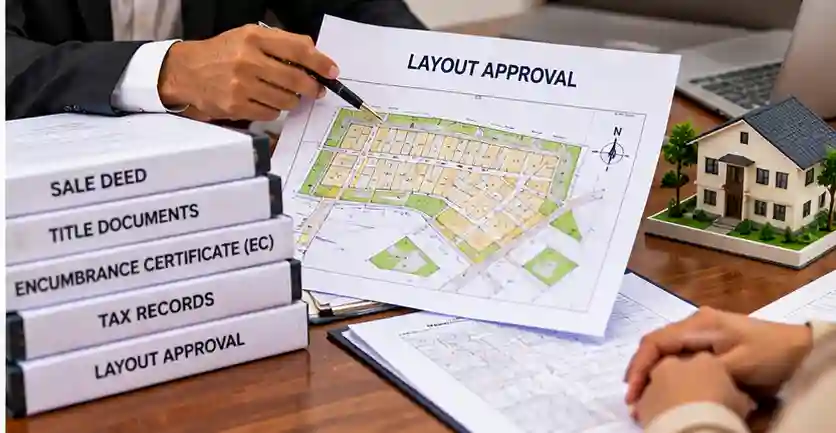
Layout approval helps buyers understand whether the proposed subdivision of land has gone through the applicable planning process.
An approved layout may contain information about:
- Individual plots
- Internal roads
- Road widths
- Open spaces
- Access
- Drainage provisions
- Layout boundaries
- Survey numbers
When you visit a site, compare what you see physically with the approved layout.
The brochure shown by a salesperson should not replace the official approved plan.
6. HMDA vs DTCP Plots: Check the Approval Number
When comparing HMDA vs DTCP plots, ask for the approval number.
You should be able to identify:
- Name of approving authority
- Approval number
- Approval date
- Layout name
- Survey numbers
- Relevant plot details
Be careful if you are shown only:
- WhatsApp screenshots
- Marketing brochures
- Posters
- Signboards
- Verbal confirmation
Ask for proper approval records before making a major payment.
7. Check Whether the Approval Is Final
Another important point is the stage of approval.
Ask whether the document being shown is:
- An application
- A preliminary/tentative permission
- A draft approval
- A final approved layout
Do not automatically assume that every approval-related document means the process is complete.
Ask:
“Can I see the final approved layout?”
Then check whether your exact plot appears in it.
8. HMDA vs DTCP Plots: Match the Plot Number
The plot you visit should match the plot shown in the approved plan.
For example, if you are considering Plot No. 35, compare:
- Plot number
- Survey number
- Dimensions
- Road-facing side
- Adjacent plots
- Boundaries
If the physical property and approved map do not appear consistent, ask for clarification.
Never assume that a plot shown at the site automatically matches the document being shown to you.
9. Check Survey Numbers Carefully
Survey numbers are an important part of land identification.
Compare the survey details across:
- Sale deed
- Approved layout
- Other title records
- Site plan
- Relevant property documents
If different records show different survey numbers or details, understand why before proceeding.
Small-looking differences in property records should not simply be ignored.
10. HMDA vs DTCP Plots: Check Road Access
Road access is another important buyer check.
Look at:
- Approach road
- Internal roads
- Road width
- Direct access to the plot
- Connection with the main road
- Actual condition of the road
A wide road shown on a brochure may not always exist in the same condition at the physical site.
Visit the exact plot and check the road yourself.
Road access can affect how practical the property is for future use.
11. Check Land Use Before Buying
Do not assume that every vacant plot can automatically be used for residential construction.
Ask about:
- Land classification
- Permitted use
- Layout status
- Applicable planning rules
- Building-related requirements
If your goal is to construct a home later, make sure the property’s intended use supports that plan.
Your purpose for buying the land should match the applicable planning requirements.
12. HMDA vs DTCP Plots: Ownership and Approval Are Different
This is especially important for first-time buyers.
Ownership documents help answer:
Who owns the property?
Layout approval helps answer:
Has the layout received the required planning permission?
These are different questions.
A property being registered does not automatically tell you everything about layout approval.
Likewise, seeing an approved layout does not remove the need to verify ownership.
Buyers should examine both.
You can also read UniqNest’s guide on First-Time Buyer Mistakes.
13. Do Not Depend Only on “Approved Plot” Advertising
Property marketing may include phrases such as:
- HMDA Approved
- DTCP Approved
- Approved Venture
- Clear Title
- Ready for Registration
Treat these as claims that need verification.
Ask for supporting records instead of relying only on promotional words.
Marketing language should start your questions, not end them.
14. Documents to Check for HMDA vs DTCP Plots
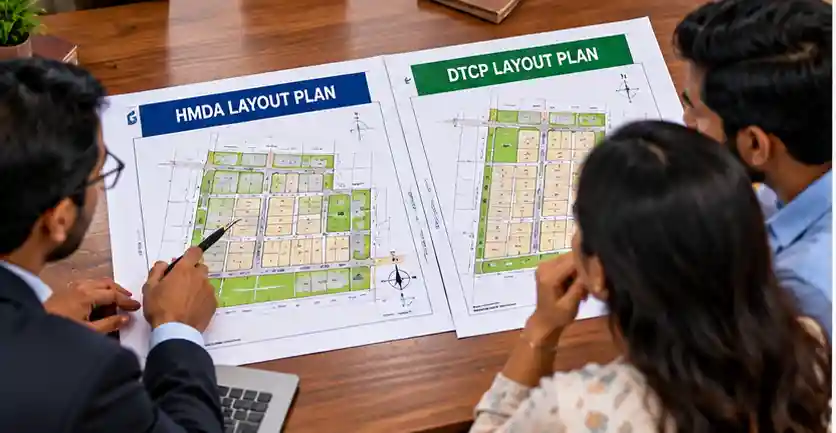
When comparing HMDA vs DTCP plots, buyers may need to review documents such as:
- Sale deed
- Previous ownership records
- Encumbrance information
- Survey details
- Approved layout plan
- Approval proceedings
- Land-use information
- Tax or revenue records
- Plot measurements
- Road-access information
If you are unfamiliar with property documents, consider getting them checked by a qualified property lawyer or appropriate professional.
You can also explore property options through the UniqNest Projects page.
15. Visit the Site Before You Decide
Documents are important, but so is physical verification.
At the site, look at:
- Plot boundaries
- Road width
- Ground level
- Drainage
- Nearby development
- Electricity access
- Water availability
- Surrounding houses
- Actual entry to the layout
Do not make a final property decision only from online photographs.
A site visit can reveal details that documents and advertisements may not show clearly.
16. HMDA vs DTCP Plots: Buyer Checklist
Use this simple checklist:
| Buyer Check | HMDA Plot | DTCP Plot |
|---|---|---|
| Correct authority for location | ✅ Check | ✅ Check |
| Approval number | ✅ Check | ✅ Check |
| Final approved layout | ✅ Check | ✅ Check |
| Survey number | ✅ Check | ✅ Check |
| Plot number | ✅ Check | ✅ Check |
| Plot dimensions | ✅ Check | ✅ Check |
| Road access | ✅ Check | ✅ Check |
| Land use | ✅ Check | ✅ Check |
| Ownership documents | ✅ Check | ✅ Check |
| Physical site verification | ✅ Check | ✅ Check |
The checklist is intentionally similar for both.
Approval authority changes with jurisdiction, but careful buyer verification remains important in either case.
Common Mistakes Buyers Should Avoid
Avoid:
- Choosing only because someone says “HMDA approved”
- Assuming DTCP plots are automatically less suitable
- Failing to check the correct jurisdiction
- Looking only at the logo on the brochure
- Ignoring the approval number
- Not checking final approval
- Ignoring survey details
- Failing to match the physical plot with the approved layout
- Assuming registration and layout approval are the same thing
- Paying before proper verification
Property decisions should be based on documents and physical checks, not labels alone.
Questions to Ask Before Buying HMDA vs DTCP Plots
Before purchasing, ask:
- Which planning authority covers this location?
- Is this an HMDA or DTCP approved layout?
- What is the approval number?
- Is this the final approval?
- Can I see the approved layout?
- Does my plot number appear correctly?
- What is the survey number?
- What are the plot dimensions?
- What road width is shown?
- Does that road currently exist?
- What is the land-use classification?
- Can I independently verify these documents?
Clear answers make property comparison easier.
FAQs About HMDA vs DTCP Plots
What is the main difference between HMDA and DTCP plots?
The main difference is generally the planning jurisdiction and approving authority applicable to the property’s location.
Are HMDA plots always better than DTCP plots?
Not automatically. Buyers should verify whether the correct competent authority has approved the layout and whether the individual property’s documents are clear.
Can a DTCP-approved plot be valid?
Yes, where DTCP is the competent planning authority for the location and the approval is valid.
Does HMDA approval prove ownership?
No. Layout approval and ownership verification are separate matters.
Should buyers check the actual approved layout?
Yes. Compare the plot number, survey details, measurements, roads and physical site with the approved layout.
Final Thoughts on HMDA vs DTCP Plots
Understanding HMDA vs DTCP plots becomes easier when you focus on the main principle:
The layout should have valid approval from the correct authority for its location.
Do not choose a property simply because the words “HMDA” or “DTCP” appear prominently in an advertisement.
Instead, check:
Jurisdiction + Approval + Ownership + Survey Details + Road Access + Physical Site
At UniqNest, you can explore different property options based on your preferred location and property type.
You can explore properties, contact UniqNest or visit the UniqNest homepage.
Check the authority. Verify the approval. Review the property. Then decide.
Disclaimer: This article is for general informational purposes only and is not legal, financial or investment advice. Planning jurisdiction, approvals and property requirements may vary and may change over time. Buyers should independently verify current official records and obtain suitable professional advice before purchasing.